Logo
Home
Archive
Log in
Get the next issue
Logo
  • Home
  • Posts
  • Salvador Dalí and His (Really) Odd Connection to the Old Masters
25 September 2026

Salvador Dalí and His (Really) Odd Connection to the Old Masters

 
What do you picture when you think of Salvador Dalí? Melting clocks? Maybe that head on stilts? Perhaps the man himself, with his wide eyes and impossibly long and pointed mustache? Whatever you imagine, it’s probably pretty weird, right? Weirdness was his whole thing (this is a guy who once hatched from a giant egg, after all), and few artists have ever done it better.
A new exhibit, however, reveals a bit of a different side to Dalí. Sure, all the weird stuff is still there, but it shows how he was a true student of art history, and that a lot of his work was directly influenced by some of the masters.
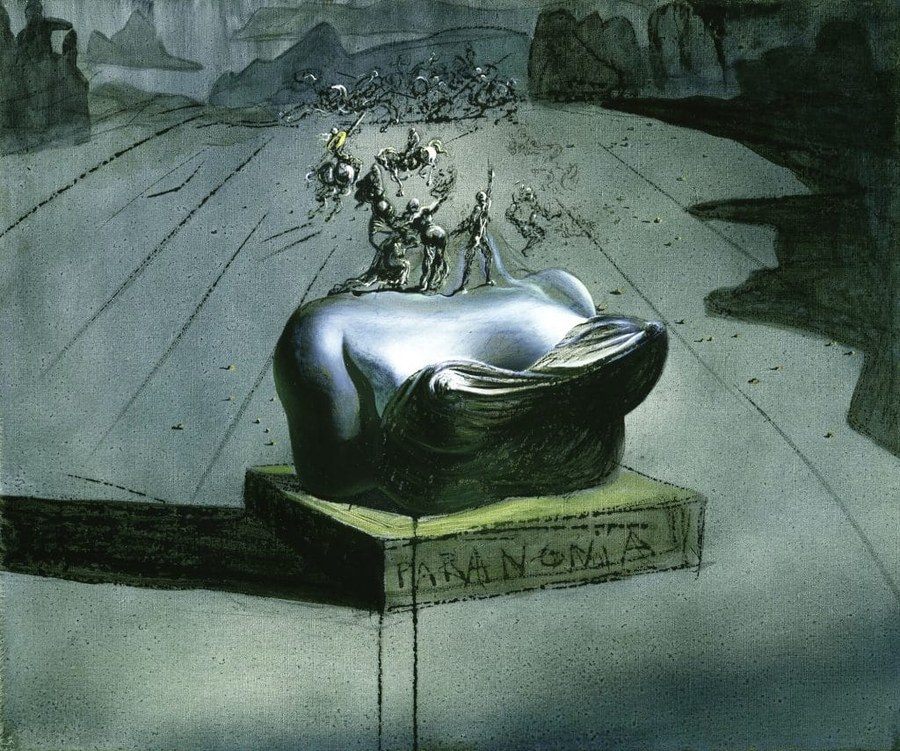
A smooth headless bust on a plinth in a grey wasteland, with tiny horsemen fighting where the head would be
A headless bust in a wasteland, its head made of tiny horsemen
Source: news.artnet.com

Dalí and da Vinci

At first glance of Dalí’s Paranonia above, you’ll see what appears to be a headless and misshapen bust in some sort of vast wasteland. Examine it a little closer, though, and you’ll see that there actually is a head (or at least the outline of one), and it’s made up of different figures – including people on horses – engaged in what might be a war. So, is this typical Dalí oddness? Sure, but this also looks a lot like the early sketches Leonardo made for The Battle of Anghiari, a fresco that to this day, nobody knows the location of or if it was ever even made.
Look at the head again, and you may see a woman’s face. Then look at Leonardo’s unfinished La Scapigliata. Do you notice a resemblance? But that’s not all. The rocks in Dalí’s work seem to be influenced by Leonardo’s The Virgin on the Rocks. Said Frederick Ilchman, co-curator of the new exhibit: “Dalí is packing so much into this, one quotation after another.”
Ilchman also believes that there may be even more to it than just a hat tip. While da Vinci was revered not only as an artist but as a scientist and inventor, Dalí also wanted to be recognized for other talents, and he dabbled in things like jewelry, film, and fashion. “We can argue that Dalí wished to be seen as a Renaissance man himself,” said Ilchman. “I think he would have been inspired by the prototype of Leonardo.”
Quoting Leonardo that heavily. Where do you land?
Tap one and the reply writes itself.
Homage
Theft with extra steps
Both, obviously
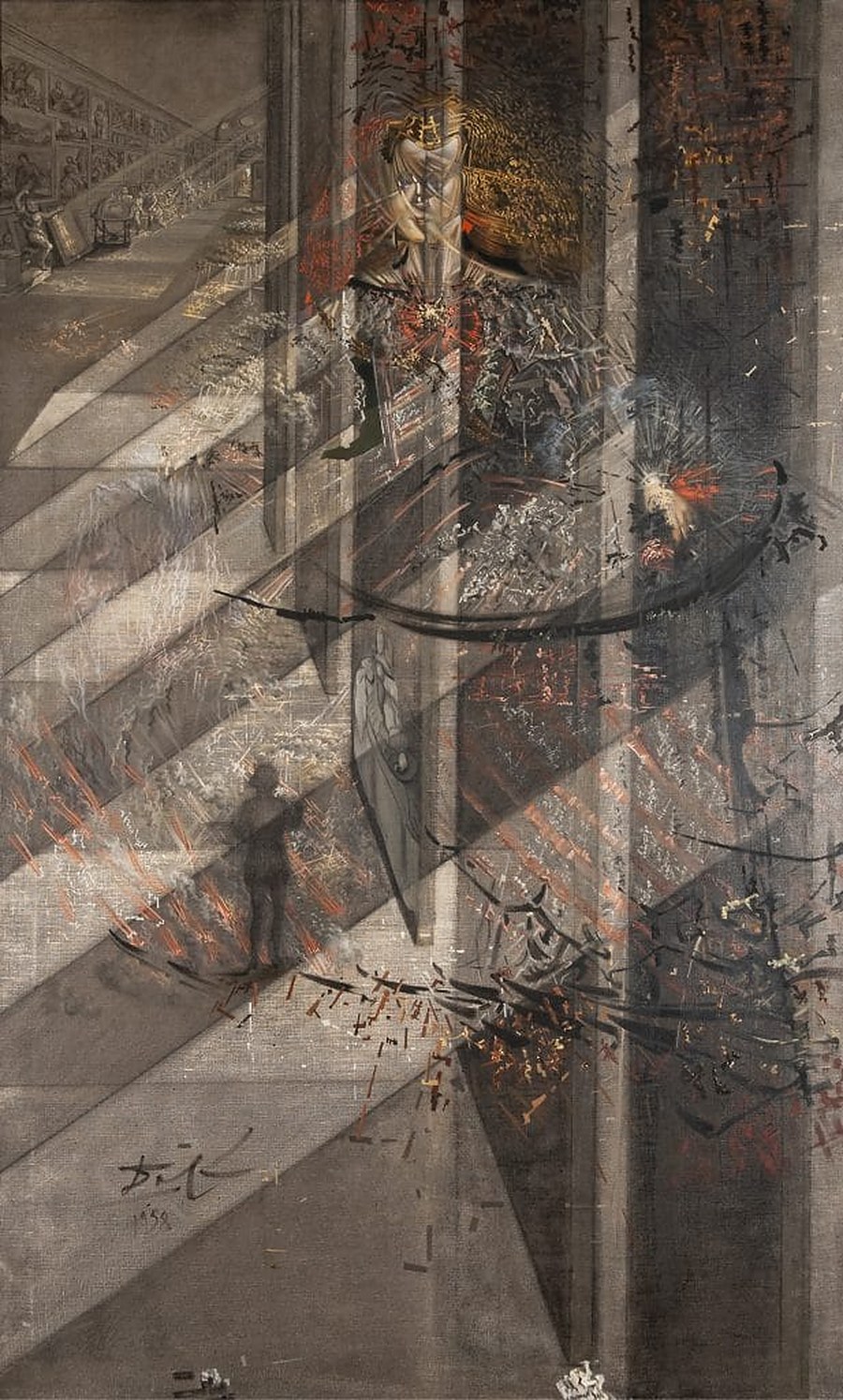
A tall surrealist painting of a figure dissolving into shafts of light in a dark museum hallway
Dalí’s tribute to Velazquez
Source: news.artnet.com

Dalí and Velazquez

The artist that Dalí seemed to think about a lot was fellow Spaniard, Diego Velazquez. When Dalí was a teenager, he founded a school magazine and wrote an essay about Velazquez that was one in a series called “The Great Masters of Painting.” In 1976, he said modern art had “revolved around a single goal: reality. And this leads us to ask: what’s new, Velazquez?”
To mark the 300th anniversary of Velazquez’s death, Dalí created Velazquez Painting the Infanta Margarita with the Lights and Shadows of His Own Glory. The work shows a woman similar to the one in the original painting, but of course with Dalí’s signature surrealist touch, which includes shafts of light, a dark museum hallway, and a shadowy figure that could be either artist. Oh, and the woman’s face is made up of rhinoceros horns (a recurring theme in Dalí’s work, as you’ll see below).
While Velazquez may have been a hero of Dalí’s, that may not be the only reason for the tribute. Said Jennifer Cohen, director of curatorial affairs at the Dalí Museum and co-curator of the new exhibit: “Often with late work like this, he’s really prodding and poking at his colleagues and trying to do them one better. He casts back to the Old Masters to supersede the most advanced painting of his era.”
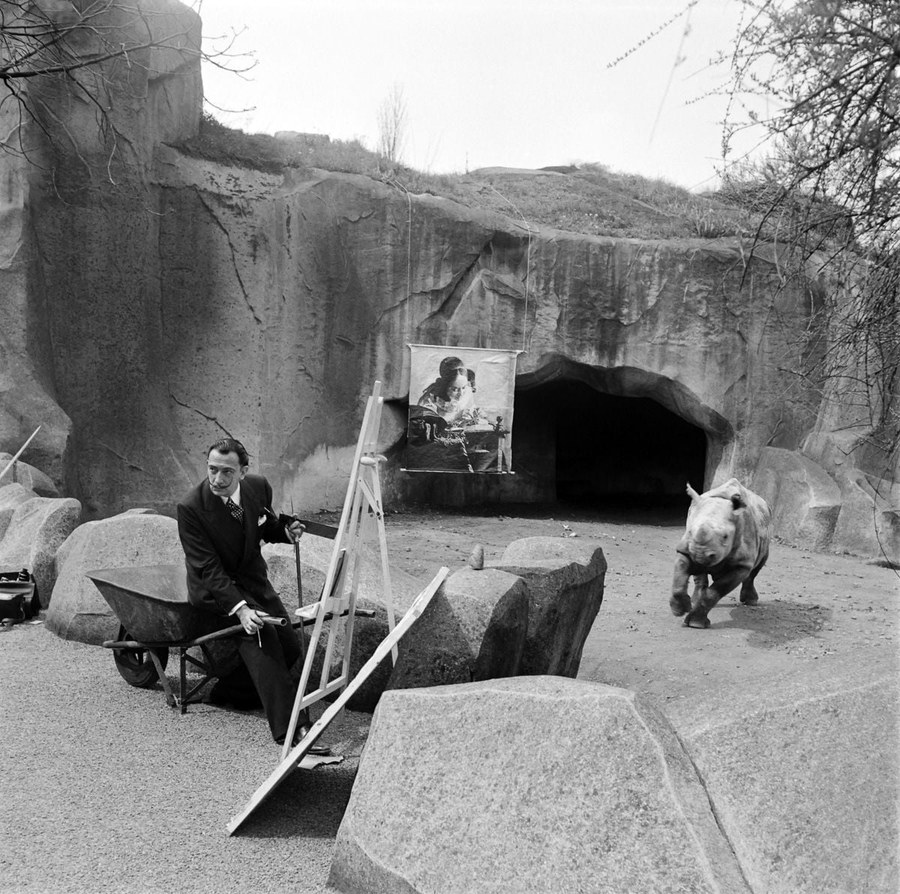
Black and white photograph of Dalí seated on a wheelbarrow before an easel in a zoo enclosure as a rhinoceros approaches
Dalí, a wheelbarrow, and François the rhino
Source: mashable.com

Dalí and Vermeer (and a Rhino)

While the new exhibit reveals Dalí’s link to the past, it doesn’t include what might be the strangest connection of them all. From an early age, Dalí became fixated on Johannes Vermeer’s The Lacemaker, saying that he became “absolutely obsessed in a truly delirious way” with it. The painting hangs in the Louvre, and in 1954, he arranged a private session in which he attempted to copy it in an hour. According to the story, after an hour, Dalí hadn’t replicated the woman, but rhinoceros horns instead.
If that’s not weird enough, it gets weirder. The next year, he brought posters of Vermeer’s painting to the Vincennes Zoo in Paris. While Dalí painted a study of rhino horns while sitting on the side of a wheelbarrow with a crust of bread on his head (naturally), his assistants dangled one of the posters into the rhino’s enclosure. The hope was that the animal (who was named François) would skewer it with its horn. When that didn’t happen, Dalí did it himself, using a lance to crash through. Does this all sound crazy? It actually happened, and you can see some real footage here.
A rhino, a lance, and a Vermeer poster. Verdict?
Tap the closest one, or hit reply and tell us in your own words. We read every note.
Peak Dalí
Unhinged
I need the footage
Something else
Art Snob
How was this issue?
One tap is all it takes.
Bad
Pretty good
Too snobby
Get the next issue

Keep Reading

Read More

Home

Archive

Terms of Use

Privacy Policy

2026 Art Snob. All rights reserved.