Logo
Home
Archive
Log in
Get the next issue
Logo
  • Home
  • Posts
  • Love Van Gogh? Thank His Sister-in-Law
29 September 2026

Love Van Gogh? Thank His Sister-in-Law

 
How many catalogs have you gotten in the mail lately? This is the time of year when they start showing up, and even if you’ve never bought anything from these companies, they’ll just fill up your mailbox anyway. And if you bother to flip through any of them, chances are pretty good that you’re going to see this artwork on a bag, umbrella, water bottle, pair of socks, or dozens of other products:
A swirling blue night sky with a bright crescent moon over a small village, and a dark cypress rising in front
Vincent van Gogh, The Starry Night
Source: thehistoryofart.org
Vincent van Gogh’s The Starry Night ranks up there with Mona Lisa and The Scream as one of the most widely known pieces of artwork in the world. People who have little interest in art know it, in large part because it’s printed on so much stuff. (Ironically, when Van Gogh was alive, nobody wanted to hang his paintings in their homes let alone wear an image of one on a fanny pack.) But, it’s quite possible that without the foresight of his sister-in-law, he would be lost to history.

Saved from Oblivion

As many people know, Vincent van Gogh died pretty much penniless. While a prolific artist who created thousands of works in his lifetime, he only officially sold just one painting that didn’t involve some charity from a family member. It’s The Red Vineyards Near Arles, which was bought by Belgian painter Anna Boch in 1890 for around 400 francs (about $2,000 in today’s money, which isn’t too shabby). Funnily enough for someone who couldn’t give his paintings away, in a letter to his brother Theo, Vincent said that Boch should’ve gotten a friend discount instead of having to pay full price.
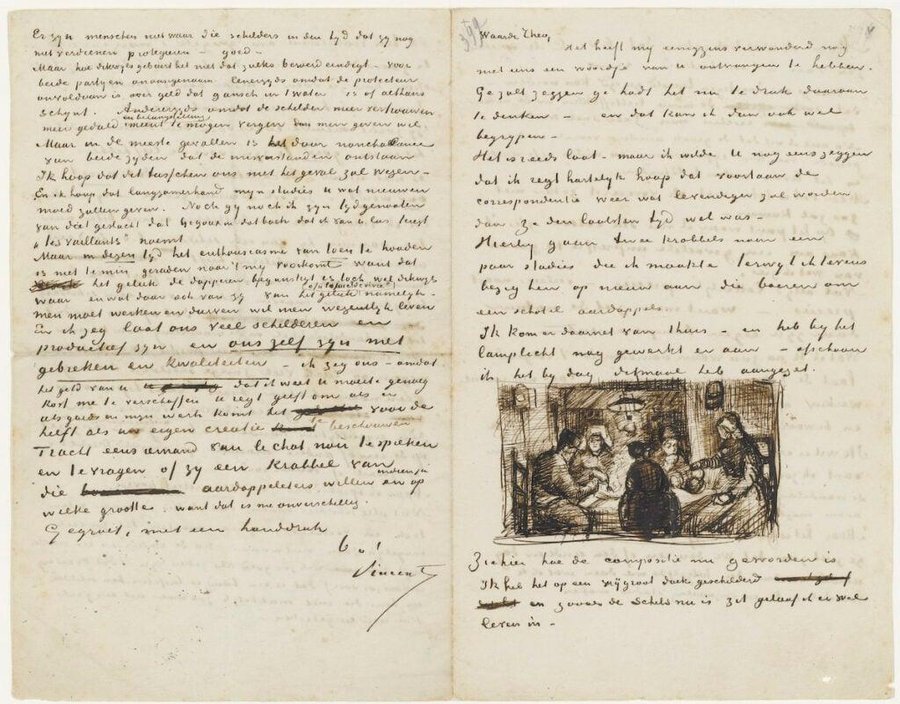
Vincent died that same year, and his brother and biggest champion died just six months later. Theo left behind his wife Johanna van Gogh-Bonger (Jo, to her friends) and their young son named Vincent. What was also left were hundreds of works by her brother-in-law filling up their small apartment. After Theo died, Jo moved back to the Netherlands and opened a boarding house to support herself and little Vincent. And while she decorated the house with many of Vincent’s paintings – she put The Potato Eaters over the fireplace – eventually she saw the potential for much more.
Two handwritten pages of a letter, with a small ink sketch of figures gathered around a table
A letter from Vincent to Theo, Nuenen, 9 April 1885
Source: dailyartmagazine.com

A Window into His World

Along with many paintings and drawings, Jo was left with over 650 letters Vincent had written to Theo, and she read them. In these, he went into painstaking detail about his work, his inspirations, the techniques he used, what he was trying to say. In addition to feeling closer to him, she really began to understand him. She was now able to recognize his brilliance, to see beauty where others only saw madness. It was the stories behind the art – and the artist – that Jo believed were the key to truly appreciating it.
Jo asked friend and art critic Jan Veth to not only look at Vincent’s paintings but to also read his letters. While reluctant at first, Jo finally convinced him, and it didn’t take him long to see what she did. In 1892, it was Veth who wrote perhaps the first public appreciation of Vincent, saying that what he once had written off as “vulgar” he now understood as gifted expressionism.
Soon, people were clamoring for Vincent’s work, and galleries all over Europe wanted to showcase it. Instead of flooding the market, however, Jo was savvy. She sent out only a select number of works to different places only on loan so people could see them but not buy them. She would also send several paintings but say that only a handful of them were actually for sale. This helped create a buzz – and a demand that paid off big time.
Lend the paintings, sell only a handful. Jo’s move?
Tap one and the reply writes itself.
Marketing genius
A little ruthless
Exactly right
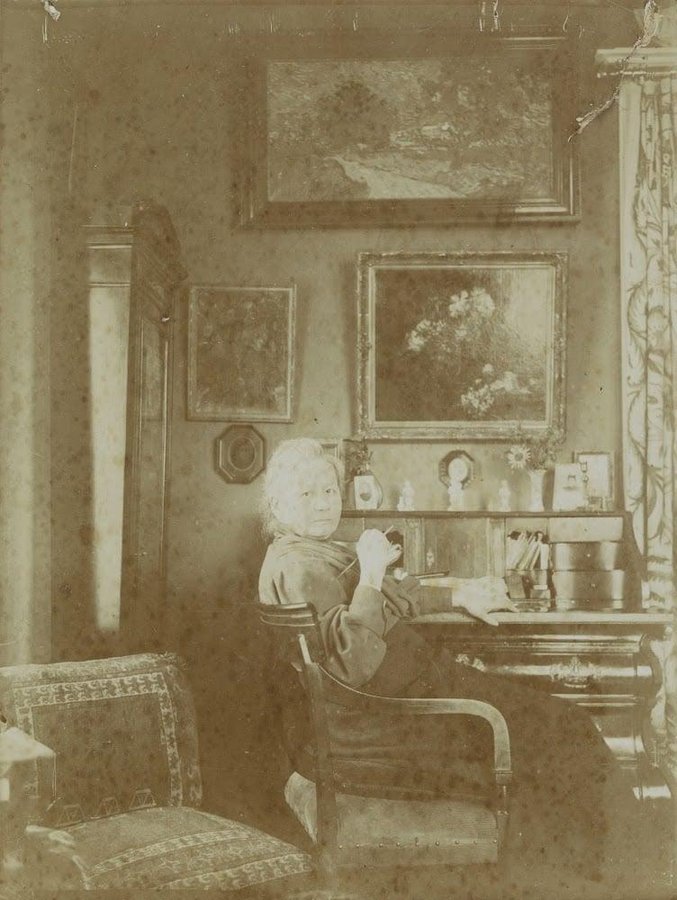
An older woman seated at a desk in a living room hung with framed paintings, in a sepia photograph
Jo van Gogh-Bonger in her living room in Amsterdam
Source: dailyartmagazine.com

Vincent’s Coming Out Party

In 1905, Jo decided that the world needed to know Vincent, and she organized a massive exhibit of his work at the Stedelijk Museum in Amsterdam. She didn’t just supply the nearly 500 artworks, however, but also put together the entire show, including deciding where things would be hung and who should be invited. It was young Vincent – now 15 – who wrote the invitations. The show was a rousing success, and people traveled from far and wide to see it. Very quickly, prices for his work doubled and tripled.
Over the last century, Vincent’s popularity has only seemed to grow, and we can thank Jo’s tireless efforts to get him the recognition he rightfully deserved. While she’d surely be perplexed by all of the merchandise bearing her brother-in-law’s artwork, she would probably be happy nonetheless. In 1923 – just two years before she died – she wrote this in a letter to French art critic Gustave Coquiot: “It’s lovely, at the end of my life, after so many years of indifference and even hostility from the public towards Vincent and his work, to feel that the battle has been won.”
The Starry Night on a fanny pack. Would Vincent laugh or cry?
Tap the closest one, or hit reply and tell us in your own words. We read every note.
Laugh
Cry
Ask for royalties
Something else
Art Snob
How was this issue?
One tap is all it takes.
Bad
Pretty good
Too snobby
Get the next issue

Keep Reading

Read More

Home

Archive

Terms of Use

Privacy Policy

2026 Art Snob. All rights reserved.