Logo
Home
Archive
Log in
Get the next issue
Logo
  • Home
  • Posts
  • Dots, Pumpkins, and an Indecent Proposal to Richard Nixon
21 September 2026

Dots, Pumpkins, and an Indecent Proposal to Richard Nixon

 
In August, the world lost an icon known for her bold style, big wigs, and outspoken views. Nope, we’re not talking about Dolly Parton, but artist Yayoi Kusama. Even if you don’t know the name, there’s a good chance you’ve seen some of the colorful work she created over seven decades. And what’s perhaps more interesting than her art is the artist herself, as she led a fascinating life that included growing up in Japan during World War II, suffering from intense hallucinations, and becoming a social media darling in her 90s. Oh, and she also once propositioned then-president Richard Nixon. But we’ll get to that.
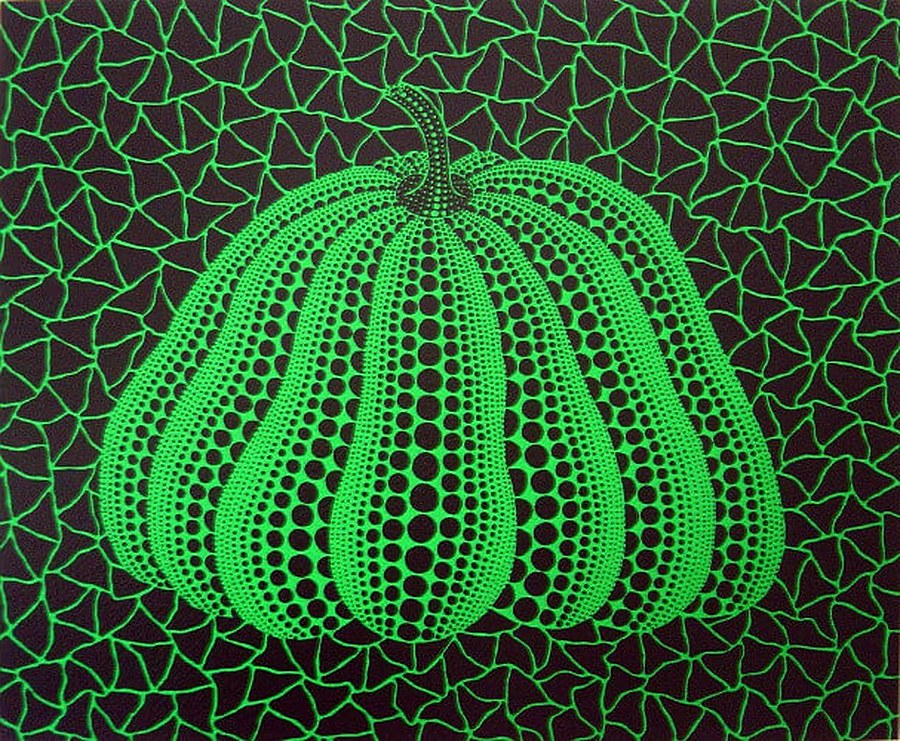
A green polka-dot pumpkin painted against a black and green webbed background
One of Kusama’s dotted pumpkins
Source: ideelart.com

Humble Beginnings

Yayoi Kusama was born in central Japan in 1929. There her family owned a plant nursery and seed farm that specialized in kabocha squash. These Japanese pumpkins would end up having a lasting impact on Kusama. When Japan entered WWII, school-age children were put to work, and she spent up to 12 hours a day in a factory sewing parachutes.
From an early age, Kusama wanted to be an artist, but her mother was adamant that she grew up to become a traditional Japanese housewife. She rejected the idea and made art whenever she could. It was around the age of 10 that Kusama experienced her first hallucination, which she described as “flashes of light, auras, or dense fields of dots.” This is a condition that has since been given the name of Visual Snow Syndrome.
She described one such vision like this: “One day I was looking at the red flower patterns of the tablecloth on a table, and when I looked up, I saw the same pattern covering the ceiling, the windows and the walls, and finally all over the room, my body and the universe. I felt as if I had begun to self-obliterate, to revolve in the infinity of endless time and the absoluteness of space, and be reduced to nothingness.”
Instead of shying away from these hallucinations, Kusama embraced them, and polka dots became the cornerstone of her creations.
Dots on every surface. How does that sit with you?
Tap one and the reply writes itself.
Soothing
Dizzying
Both at once
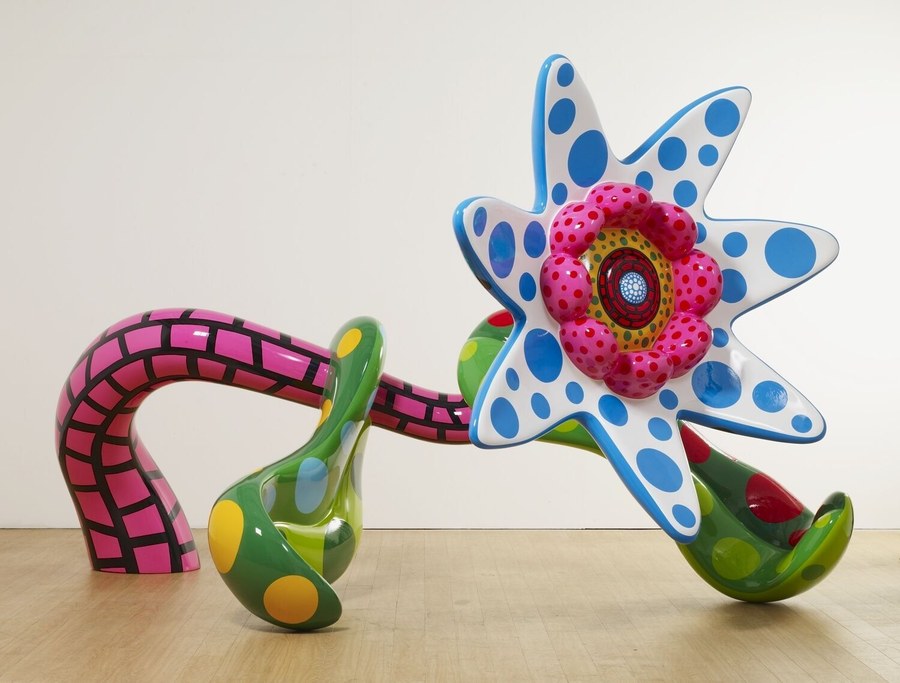
A large polka-dot flower sculpture in pink, green, blue and white standing in a gallery
A polka-dot flower sculpture in the gallery
Source: victoria-miro.com

Hippy Happenings

In the late 1950s, Kusama moved to America. After a brief stint in Seattle, she settled in New York City, and it didn’t take her long to establish herself in the art scene. Her vibrant dots seemed particularly perfect for the psychedelic 60s and 70s, and it really resonated with hippie culture. As did her stances against injustice and war. To protest the conflict in Vietnam, Kusama put together happenings in which she would paint polka dots on the nude bodies of protestors.
In 1968, she staged an “Anatomic Explosion” event, which the press release described as a “naked demonstration” in Wall Street, and in which she urged people: “Don’t pay taxes…Burn Wall Street…OBLITERATE WALL STREET MEN WITH POLKA DOTS.”
That same year, she sent a satirical letter to Richard Nixon (she described his body as “hard” and “masculine”) and offered him sex in exchange for an end to the war.
“Our earth is like one little polka dot, among millions of other celestial bodies, one orb full of hatred and strife amid the peaceful, silent spheres,” she wrote. “Let’s you and I change all that and make this world a new Garden of Eden. Let’s forget ourselves, dearest Richard, and become one with the Absolute, all together in the alltogether [sic]. As we soar through the heavens, we’ll paint each other with polka dots, lose our egos in timeless eternity, and finally discover the naked truth: You can’t eradicate violence by using more violence.”
A letter to a sitting president. Verdict?
Tap the closest one, or hit reply and tell us in your own words. We read every note.
Genius protest
Deeply strange
Both, obviously
Something else
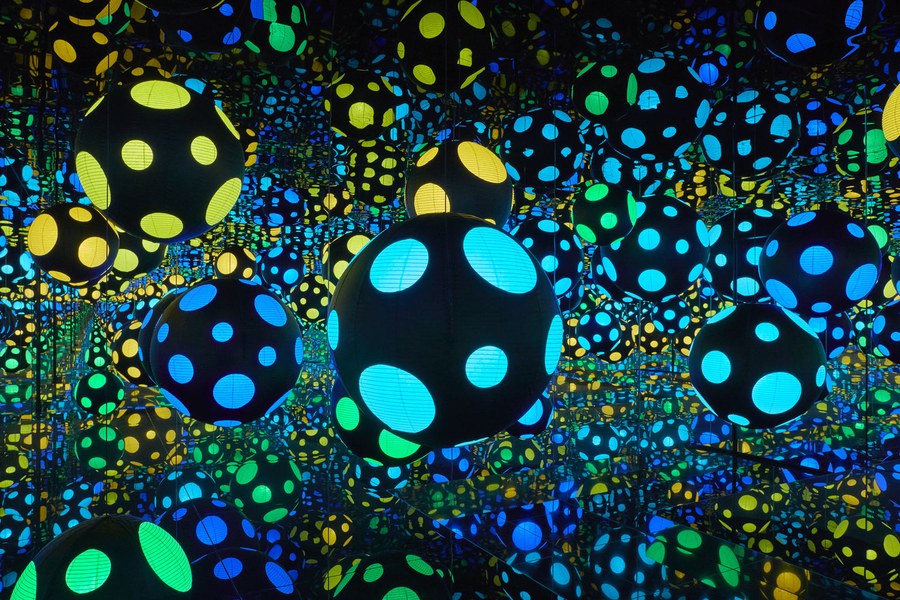
Glowing dotted spheres reflected endlessly in a mirrored room
Inside one of the mirrored Infinity Rooms
Source: victoria-miro.com

Infinity and Beyond

Along with her dots, Kusama is probably best known for her mirrored Infinity Rooms. These were closed-off spaces in which all surfaces were covered in mirrors. When objects or lights or polka dots were introduced, it would appear as though these images stretched on infinitely.
Kusama also upped the ante at times to make experiences even more unbalanced for viewers. “She shocked the living daylights out of people,” said Richard Castellane, her dealer in the 60s. He recalls that one of her mirrored rooms was full of phalluses. In another, a machine would set off blinking colored lights in a rhythm like a machine gun. “And what occurred, of course, was the lights would bounce from mirror to mirror to mirror to mirror,” he remembered. “You couldn’t focus on anything. You had no sense of space because space was infinite.”
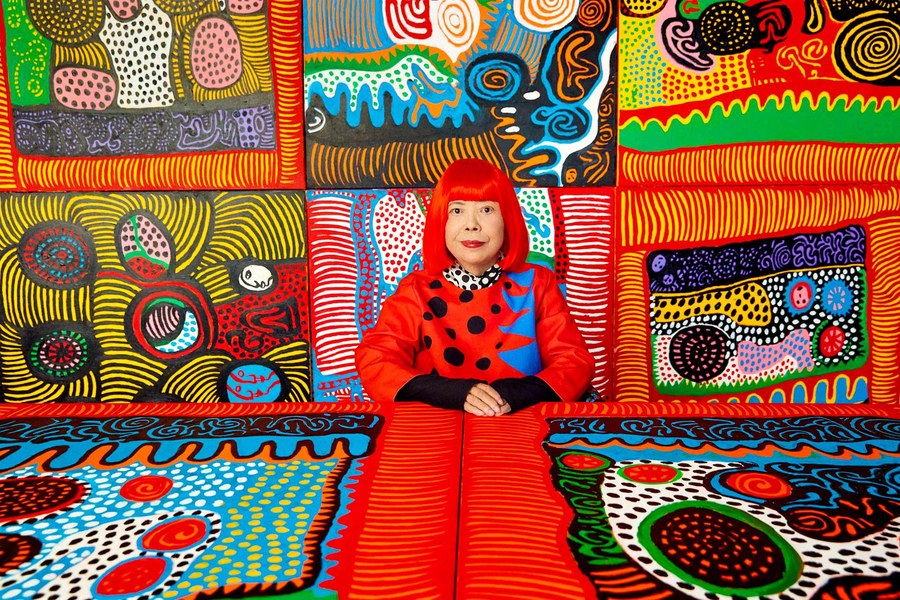
Kusama in a red wig and red coat seated among her brightly patterned paintings
Kusama among her paintings
Source: guggenheim-bilbao.eus

Escape from Society and a Social Reemergence

Despite being a well-regarded artist, Kusama struggled to eke out a living, and perhaps as a result, her hallucinations became worse. She also suffered severe panic attacks. After moving back to Japan in the 70s, she checked herself into a psychiatric institution, and that’s where she spent the rest of her life. This didn’t stop her from creating, however, as she continued to work at a studio across from the hospital.
But Kusama didn’t drop out of public consciousness. In fact, thanks in large part to social media, and especially Instagram, her art has never been seen by more people. In recent years, she has been introduced to countless new fans, as visitors to her exhibits in museums around the world are continually enthralled with her striking work and are eager to take pictures and videos and upload them to the platform.
Kusama may be gone, but she definitely won’t be forgotten anytime soon. In her 2002 autobiography, she discussed her legacy, writing: “If, a hundred years from now someone were to see my art and think ‘Kusama did some really good work,’ I would be satisfied.”
Art Snob
How was this issue?
One tap is all it takes.
Bad
Pretty good
Too snobby
Get the next issue

Keep Reading

Read More

Home

Archive

Terms of Use

Privacy Policy

2026 Art Snob. All rights reserved.